If you're reading this at eleven at night with six tabs open, here's the short answer first. Therapeutic riding — often called adaptive riding — is riding instruction shaped around an individual rider, and some autistic children genuinely love it. Some don't. It isn't a treatment for autism, and nobody honest will tell you it is.
Your child isn't a problem to be solved. So this post isn't about outcomes or progress. It's about whether a barn is a place your child would enjoy being, what actually happens there, and how to tell a good barn from a careless one before you commit to anything.
Everything below applies to any barn you're considering, not just ours.
What a therapeutic or adaptive riding session usually involves
Less riding than most people expect, especially at the start. A typical session is built in layers, and a lot of the value sits in the parts that happen with both feet on the ground.
- Arriving and settling. Time to look around, hear the sounds, and get used to the size of everything before anyone asks for anything.
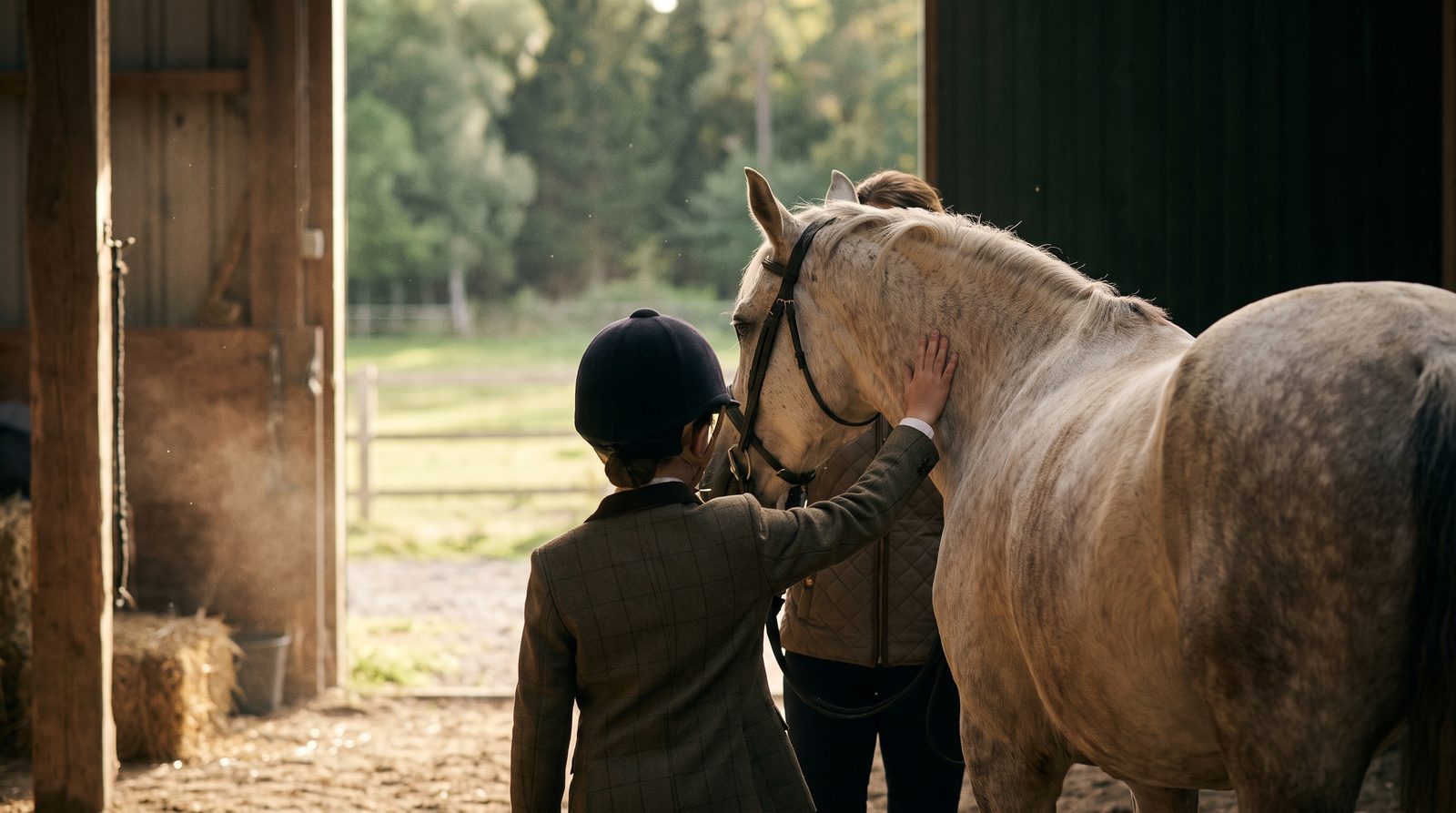
- Meeting the horse. Standing near it, touching its neck, learning where it's safe to stand and how to approach.
- Groundwork. Grooming, leading, holding a halter, walking beside the horse. Repetitive, hands-on, and satisfying in its own right.
- Mounting and riding, when the rider's ready. Often walking only, with helpers alongside. This might happen on day one, or on the fourth visit, or it might not be the part your child cares about at all.
- Putting the horse away. A clear ending. Sessions that finish on a defined task tend to end better than ones that just stop.
The order rarely changes, and that's deliberate. A predictable shape is often more useful than any single activity in it.
Why the barn itself is often the appealing part
Parents often say the horse was only half of it. The environment does a lot of the work.
There's rhythm and repetition everywhere. The walk of a horse is steady and regular. Brushing is repetitive. Leading is a loop of the same few steps. For a child who seeks that kind of input, a barn is full of it without anyone having to manufacture it.
The sensory input is real, and it's varied. Warm coat, coarse mane, the weight of a brush, the smell of hay, wide open space, sunlight, wind. For some children that's settling and wonderful. For others it's far too much at once, which is exactly why a low-pressure first visit matters more than a booking.
The routine is visible. The same gate, the same aisle, the same horse, the same order of tasks. Not a routine imposed on the child, just how a barn already runs.
The horse doesn't judge. It doesn't need eye contact, doesn't mind silence, doesn't require small talk, and doesn't react to stimming. It responds to what you actually do around it. Many families describe that as the part their child relaxes into.
The goal of a first visit isn't to ride. It's to find out whether your child likes being there at all. That's a real, useful answer either way.
What a first visit might look like
Ask any barn to describe this before you go, and see whether the answer sounds flexible.
A good first visit is short and mostly about looking. Walking the aisle. Watching someone else's lesson from the fence. Standing near a horse without being asked to touch it. Meeting whoever would be teaching. Leaving before anyone's had enough.
Riding may not happen, and that shouldn't be treated as a failure by anyone present, including you. If your child spends twenty minutes fascinated by a wheelbarrow and never goes near a horse, you've still learned something worth knowing about whether this place works for them.
If it helps to see the standard shape of a beginner session first, our walkthrough of what to expect in a first riding lesson lays out how a typical lesson runs from the parking lot onward.
What to ask and look for at any barn
This is the part worth taking notes on. Ask these of every barn you call, and pay as much attention to how they answer as to what they say.
- What training does the instructor have? Ask specifically about experience teaching riders with disabilities or additional needs, and what that training was. A straight answer beats a vague reassurance every time.
- How many helpers per rider? Depending on the rider, a session might involve someone leading the horse and one or two people walking alongside. Ask what they'd plan for your child, and why.
- What's the helmet and safety policy? Helmets should be non-negotiable and provided. Ask how they fit them, and what they do if a child won't wear one.
- Can we visit and watch before booking anything? This is the single most revealing question. A barn that welcomes an observation visit is telling you it has nothing to hide and understands why you're asking.
- What happens when a session isn't going well? Listen for a plan: slow down, get off, move to groundwork, take a break, end early without fuss. Be wary of any answer built around pushing through it.
- How do you communicate with parents? Where you'll be during the session, whether they'll talk to you afterward, and how you'd share what does and doesn't work for your child.
- How do you adapt to sensory needs? Noise, crowding, unexpected touch, transitions between activities. Ask whether quieter times of day are possible and whether the same horse and same person can stay consistent.
The tone of the answers matters. You're listening for people who are curious about your specific child rather than people describing a program. More general guidance on evaluating a barn is in our post on how to choose a riding lesson barn.
Signs a barn is a good fit, and signs it isn't
Some of this you'll only pick up by standing there.
Good signs: the horses look relaxed and well cared for. Staff talk to your child directly, not only to you. Somebody asks what your child likes and what they find difficult, and writes it down. Nobody rushes. When you ask a question they don't know the answer to, they say so.
Signs to slow down: promises about what riding will do for your child. Outcome language, statistics, or claims of proven benefits. Reluctance to let you watch first. A session plan that can't bend. Anyone treating a child's discomfort as something to be pushed through.
And the thing worth repeating: every autistic child is different. What one child finds calming, another finds overwhelming. Nothing on this page — or on any barn's page — can tell you which is true for yours. Your family's own care team knows your child and is the right place to think this through.
An honest next step
Thunder Ridge Farms is a working American Saddlebred farm in Phillipsburg, NJ. We teach Saddle Seat and Western riding, we board, train, breed and sell horses, and we offer equine therapy services. What we're not going to do is tell you what riding will do for your child, because we don't know your child.
So the honest next step isn't a booking button. It's a conversation. Call us at (484) 221-3950 or email info@thunderridgefarms.biz, tell us about your child, and ask what would actually work for them — including whether it would work here at all. We'd rather have that conversation than have you find out the hard way on a Saturday morning.
If, after talking, your child would enjoy a short, low-pressure visit and some time on a horse, one place to start is our 30-minute trial lesson for $60 — no experience and no gear needed, for riders aged 6 and up. Our guide to riding lessons in Phillipsburg, NJ explains how lessons work here, and if you're still sorting out the wider vocabulary, we've written a plain-English primer on equine assisted therapy in NJ. We're open Tuesday through Sunday, 10 AM to 8 PM, and closed Mondays.