The short version: English and Western riding differ mainly in the saddle you sit in, how you hold the reins, and how you sit. Everything else people argue about grows out of those three things.
The longer version is more interesting, because the two styles didn't diverge for fashion reasons. They were built for different jobs. Once you know what each one was originally for, the gear stops looking arbitrary and starts making sense.
We teach both Western and Saddle Seat here in Phillipsburg, NJ, so we have no reason to sell you on one over the other. Here's the honest comparison, plus the part most articles leave out at the end.
The saddle, and why the two look so different
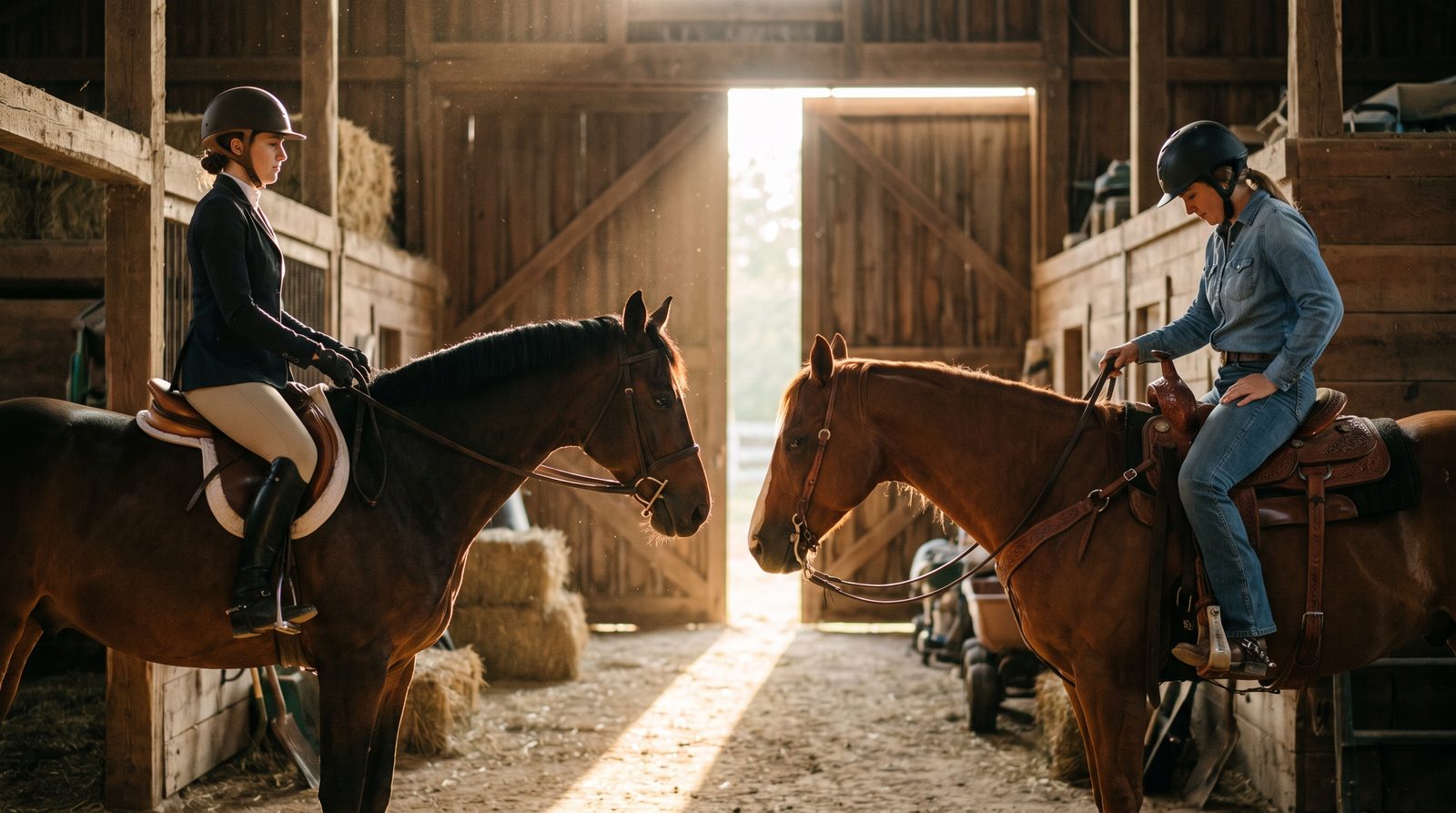
Put an English saddle and a Western saddle side by side and you'll spot the difference from across the barn. One is small, flat, and light. The other is deep, heavy, and has a horn on the front.
That isn't decoration. A Western saddle spreads the rider's weight over a much larger area of the horse's back, because it was designed for people who'd be in it all day. It's built like a working chair: deep seat, wide fenders, a lot of leather between you and the horse. That bulk is exactly why so many first-timers feel steadier in one.
The horn is a tool, not a handle. It was there to dally a rope around when working cattle. Beginners grab it anyway, and that's fine on day one, though a good instructor will quietly get your hands off it soon enough.
An English saddle goes the other way. Less leather, closer contact, and nothing much between your seat bones and the horse's movement. You feel more, which is the point, and you're also asked to carry more of your own balance. Neither approach is better. One prioritizes security and endurance. The other prioritizes feel.
Reins and hands: two-handed contact vs. neck reining
This is the difference you'll notice within your first ten minutes.
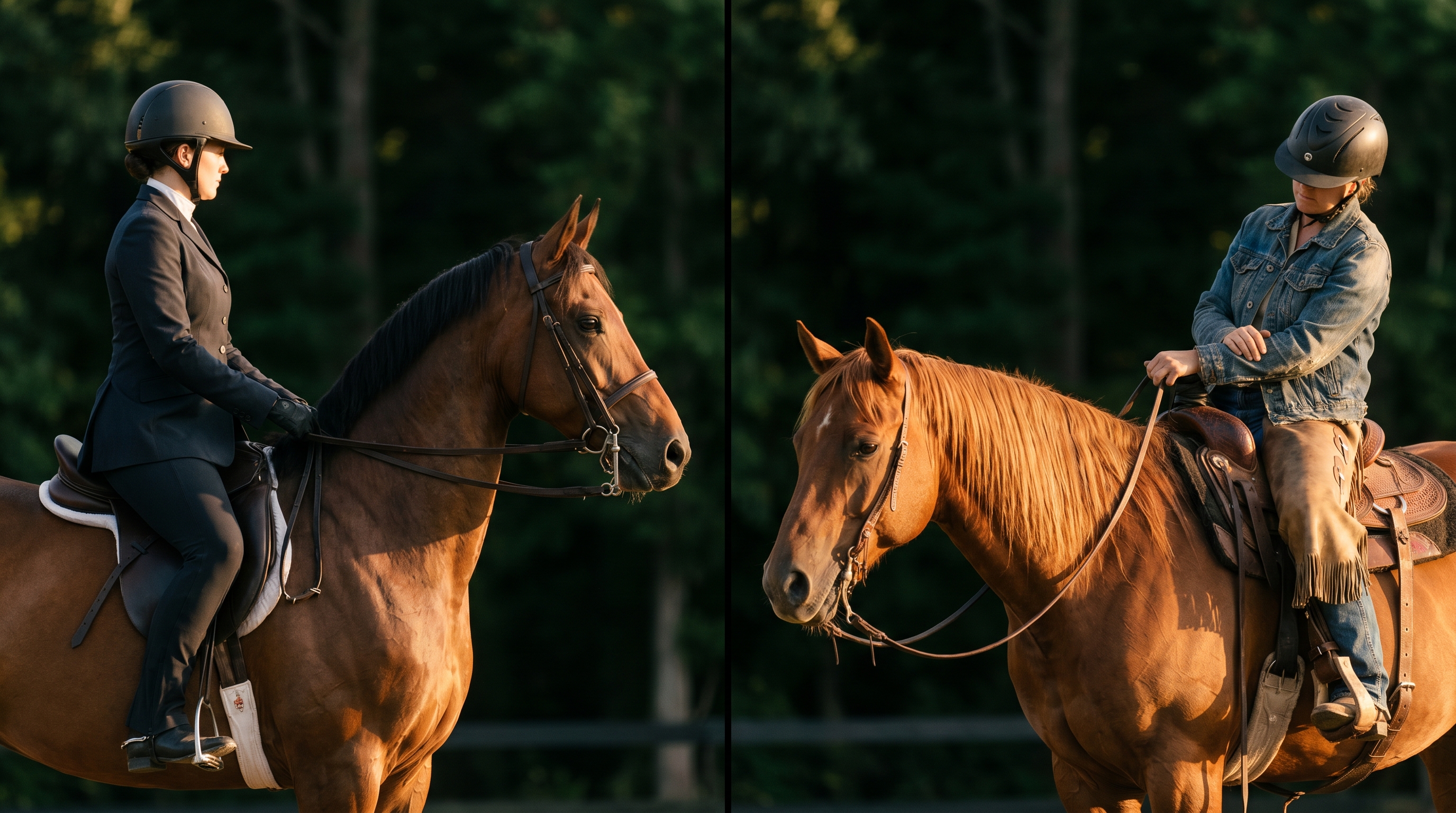
- English: a rein in each hand, with a light, steady connection to the horse's mouth. You steer and communicate through both hands, and the contact is more or less continuous.
- Western: both reins in one hand, usually held loosely. You steer by laying the rein against the horse's neck, which is called neck reining, and the horse moves away from that pressure.
Neck reining looks effortless because it is, once the horse knows it. But it's a trained response the horse learns over time. That's part of why Western horses are often described as reading subtle cues: the rider isn't holding a running conversation through the reins, so the leg, seat, and weight have to carry more of the message.
English contact feels chattier. There's a small, constant back-and-forth going on through your hands. Beginners often find this the harder half to learn, because your hands want to grab when you lose your balance, and quiet hands take a while.
Seat, leg, and what your body is doing
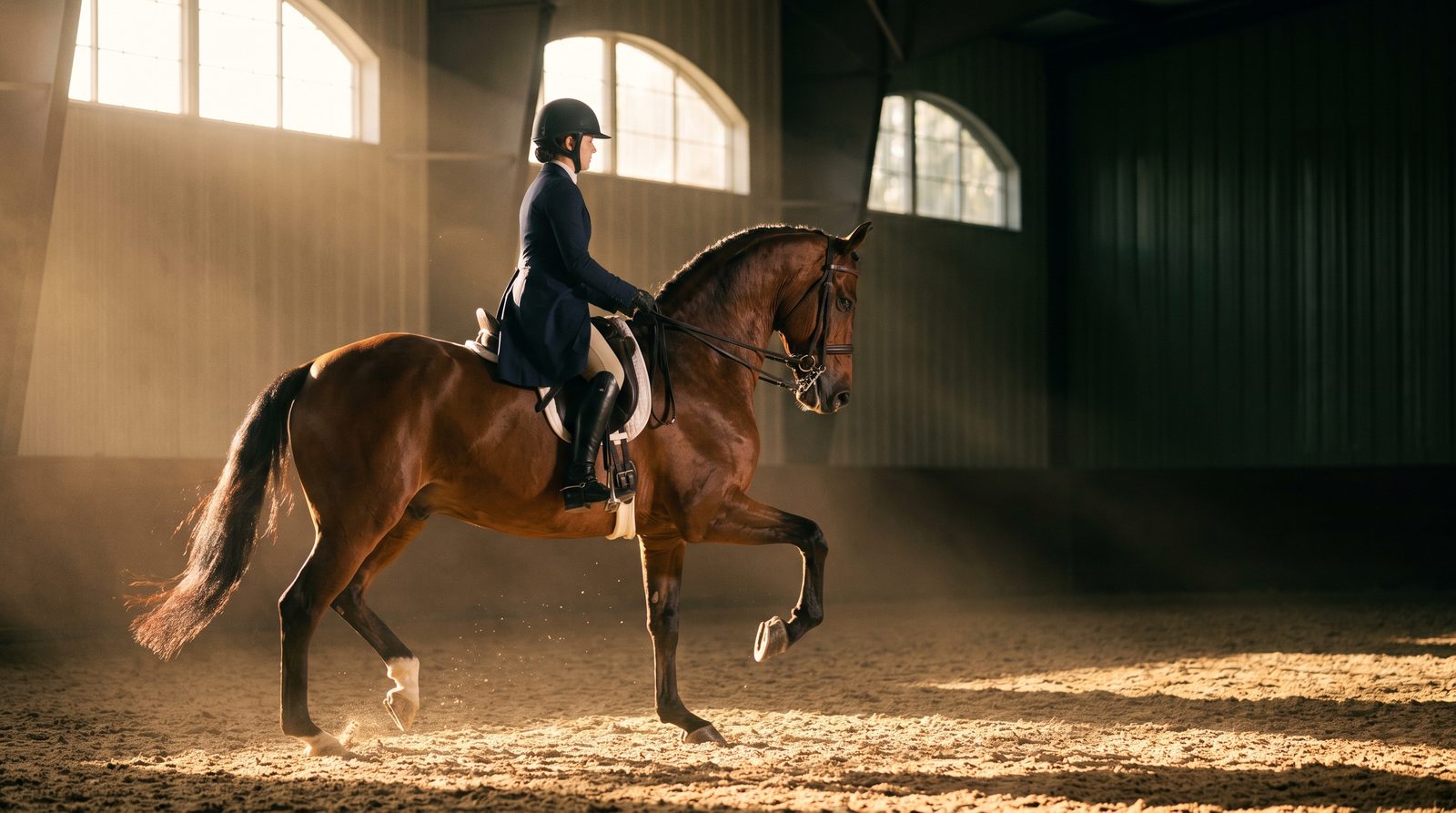
English riding generally asks for a taller, more upright body, shorter stirrups, and a leg that's actively involved in every stride. At the trot, English riders often post, rising and sitting with the rhythm. It's a genuinely new physical skill and one of the most satisfying things to finally get right.
Western riding sits deeper and longer. Stirrups drop, the leg hangs straighter, and the whole posture is more relaxed. The classic Western jog is meant to be sat rather than posted, which is why the gait itself is bred and trained to be smooth.
What surprises people is that both styles are demanding in their own way. English asks for more precision and more core. Western asks you to stay quietly balanced and still while doing much less with your hands. Riders who assume Western is the easy one usually change their minds the first time an instructor asks them to stop using the reins as a crutch.
What each tradition was actually built to do
This is the framing that makes the whole comparison click.
Western came from work. Ranch riding, cattle, long distances, uneven ground, one hand busy with a rope. Everything about the tack and the seat is built for a rider who needs to stay secure, comfortable, and useful for hours, on a horse that can think for itself.
English came from the field, the cavalry, and later the show ring. The English family covers a range of disciplines, and they share an emphasis on closer, more refined communication between horse and rider, and on presentation in the ring. The lighter tack exists because the rider is meant to feel and influence the horse more directly.
Western says: keep me secure and comfortable while I do a job. English says: let me feel everything so we can do this together, precisely.
Neither philosophy is the real way to ride. They're two sensible answers to two different questions.
What each one feels like on day one
Gear-wise, a first lesson in either style is the same: long pants and closed-toe shoes, and we provide the helmet. Nobody needs boots, breeches, chaps, or a hat to start. Those come later, if they come at all.
The feel is where it splits:
- A first Western ride tends to feel reassuring. There's a lot of saddle around you, the pace is calm, and the horn gives your hands somewhere to go while your brain catches up.
- A first English ride feels more exposed and gives more feedback. You notice the horse's back moving underneath you almost immediately, which is thrilling for some people and unnerving for others.
Neither is risk-free, but both are sensible places to start with a calm, well-trained horse and an instructor beside you. If nerves are the main thing on your mind, say so when you book. A good instructor will slow the whole thing down for you, and that makes more difference than which saddle you pick.
The honest part: for a real beginner, this decision matters less than you think
Here's what most English vs. Western riding comparisons won't tell you, because a confident verdict makes for a tidier article.
For your first several months, you're learning the same things either way:
- Balance. Staying centered over a moving animal. Completely universal.
- Steering. The mechanism differs. The concept of asking clearly and waiting for a response does not.
- Stopping. The most reassuring skill in riding, and it transfers directly.
- Reading a horse. Noticing ears, tension, and mood. This is what separates a rider from a passenger, and no saddle teaches it faster than another.
Riders switch disciplines all the time without starting over, because the fundamentals carry.
What actually decides whether you stick with riding is the barn and the instructor. Whether they explain things in plain language. Whether the horses are calm and genuinely suited to beginners. Whether you get rushed. Whether you leave wanting to come back. If you're weighing options, our guide on how to choose a riding lesson barn lays out what to look at first, and that choice matters far more than English or Western.
Where Thunder Ridge fits, and a word about Saddle Seat
We teach Western and Saddle Seat, plus driving. We're American Saddlebred specialists, so Saddle Seat runs deep here.
One precision point, because this trips people up constantly: Saddle Seat belongs to the English family, but it is not hunt seat. Different saddle, different posture, different purpose. Saddle Seat is built to display the high, animated action of gaited and high-stepping breeds like the Saddlebred. It isn't dressage, and it doesn't involve jumping. So if you've read a generic English-vs-Western article and pictured a hunt seat rider going over fences, that isn't what English means here.
If Saddle Seat is the branch you're curious about, start with what Saddle Seat riding actually is, then read the head-to-head on Saddle Seat vs. Western riding, which gets specific about tack and posture in a way a broad comparison can't. For the full picture of how lessons work here, see our guide to horse riding lessons in Phillipsburg, NJ.
Ten minutes in a saddle will settle this question better than another hour of reading. Come try one. Your first visit is a 30-minute trial lesson for $60, with no experience and no gear needed, and nothing to sign up for afterward. When you're ready, book your 30-minute trial lesson, or call us at (484) 221-3950 and we'll talk it through first.